Thursday, January 2, 2014

Fwd: 100 Spectacular Night Sky Photos of 2013


Sent from my iPad

Begin forwarded message:

From: Kent Castle <kent.d.castle@hotmail.com>
Date: January 2, 2014 4:29:38 PM CST
To: Choban Peter <peter.s.choban@aero.org>, Bogan Carole <bcbogan@earthlink.net>, Reason Marilou <loganlou55@yahoo.com>, Madsen Ron <ronstar@pdq.net>, Chamberlain Sharon <sharon.m.chamberlain@saic.com>, Martin Bobby <bobbygmartin1938@gmail.com>, Alewine Robert <aboba0620@aol.com>, Baird Darren <darren.t.baird@nasa.gov>, Sutherland Aurora <fuentesd11@yahoo.com>, Schwering Suanne <suannesch@mac.com>, Hooi Robert <rwlh21@sbcglobal.net>, Naftzger George <inntiqui@ffni.com>, Heidel TQ <bheidel@highland.net>, Tetzloff Connie <owari567@comcast.net>, Leach Larry <ljleach@tds.net>, Williams Tom <gtomwill@att.net>, "lrodriguez@neighborhood-centers.org" <lrodriguez@neighborhood-centers.org>, "Russell, Jody (JSC-AD93)[DB Consulting G" <mary.j.russell-1@nasa.gov>, Castle Kerrick <kjcastle@hotmail.com>, Hultberg Jane <jhultberg@coa.edu>, Carman Gilbert <gil77546@sbcglobal.net>, Astrology Valkyrie <astrogoddess@valkyrieastrology.com>, Bentz Jerry <bentz@sbcglobal.net>, Lozano Marianne <kemahsabe@comcast.net>, Castle Kecia <kbccat@yahoo.com>, Arnold Jenny <arnoldrj@bellsouth.net>, Homann Gus <gus-homann@ix.netcom.com>
Subject: FW: 100 Spectacular Night Sky Photos of 2013


From:
Subject: FW: 100 Spectacular Night Sky Photos of 2013
Date: Sun, 29 Dec 2013 21:28:52 -0600


100 Spectacular Night Sky Photos of 2013

2013, December, 27 17:19


Inline image 1


100 Spectacular Night Sky Photos of 2013

by SPACE.com Staff   |   December 27, 2013 12:18pm ET


PREVIOUS | NEXT

1 of 96

Los Volcanes, Venus y la Luna

Credit: Eduardo Davila

This stunning photo of Venus and the moon was taken in the early morning hours of Jan. 10th, 2013 from Santa Fe in the west side of Mexico City, Mexico by Eduardo Davila.


Copyright © 2013 TechMediaNetwork.com All rights reserved.


===============================================================


Fwd: Special Bucket List


Sent from my iPad

Begin forwarded message:

From: Kent Castle <kent.d.castle@hotmail.com>
Date: January 2, 2014 4:25:52 PM CST
To: Patterson James <w8ljz@aol.com>, Bogan Carole <bcbogan@earthlink.net>, Chamberlain Sharon <sharon.m.chamberlain@saic.com>, Madsen Ron <ronstar@pdq.net>, Alewine Robert <aboba0620@aol.com>, Martin Bobby <bobbygmartin1938@gmail.com>, Julian Robert <rwj1007@comcast.net>, Astrology Valkyrie <astrogoddess@valkyrieastrology.com>
Subject: FW: Special Bucket List


Date: Mon, 30 Dec 2013 22:59:44 +0000
From:
Subject: Fwd: Special Bucket List


From: To:
Sent: Monday, December 30, 2013 10:59:55 AM
Subject: Special Bucket List


 We are getting old and our tickers aren't what they used to be...so here is


Our Special Bucket List for


2013,14,15,16.... 

HERE


IS ALL WE


WANT... 

1.


Obama: Gone! 


2.


Put "GOD" back in America !!! 


3.


Borders: Closed! 


4.


Congress: On the same retirement & healthcare plans as everybody else


.


5.


Congress: Obey its own laws


NOW! 


6.


Language: English only! 


7.


Culture: Constitution, and the


Bill of Rights! 


8.


Drug Free: Mandatory Drug


Screening before & during Welfare! 


9.


NO freebies
to Non-Citizens! 


10.


Balance the budget.


11.


Stop giving away our money to foreign countries! Charge them for our help!
We need it here.


12.


Fix the TAX CODE!

And


most of all.


13.


"RESPECT


OUR MILITARY AND OUR FLAG!!" 


We the people are coming!


Only 86% will send this on.


Should be a 100%.
What will you do?


Please send it on if only to one person.


In GOD We TRUST!


No virus found in this message.
Checked by AVG - www.avg.com
Version: 2014.0.4259 / Virus Database: 3658/6953 - Release Date: 12/27/13

No virus found in this message.
Checked by AVG - www.avg.com
Version: 2014.0.4259 / Virus Database: 3658/6953 - Release Date: 12/27/13


Fwd: Curiosity Celebrates 500 Sols Spying Towering Mount Sharp Destination


Sent from my iPad

Begin forwarded message:

From: "Gary Johnson" <gjohnson144@comcast.net>
Date: January 2, 2014 2:33:31 PM CST
To: "Gary Johnson" <gjohnson144@comcast.net>
Subject: FW: Curiosity Celebrates 500 Sols Spying Towering Mount Sharp Destination


Inline image 1

Happy New Year's Day 2014 from Mars – Curiosity Celebrates 500 Sols Spying Towering Mount Sharp Destination

by Ken Kremer on January 1, 2014

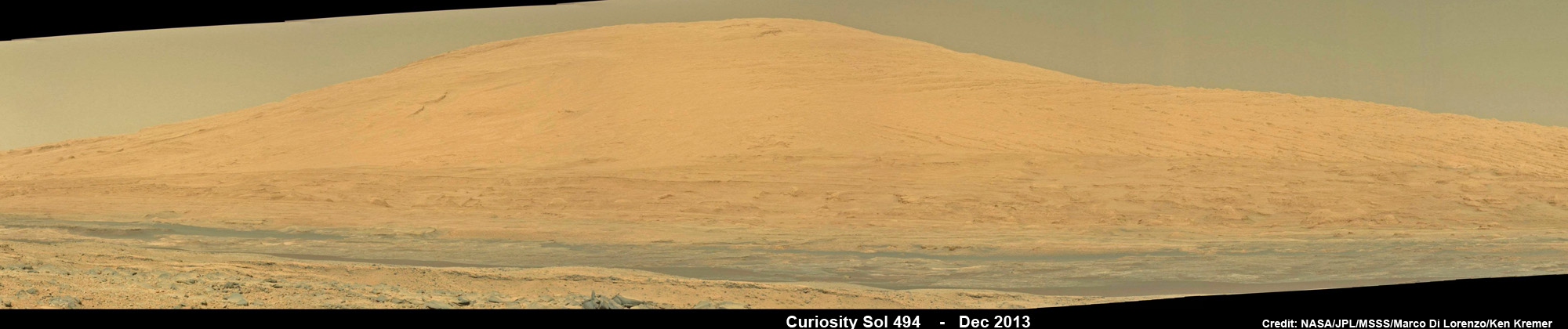
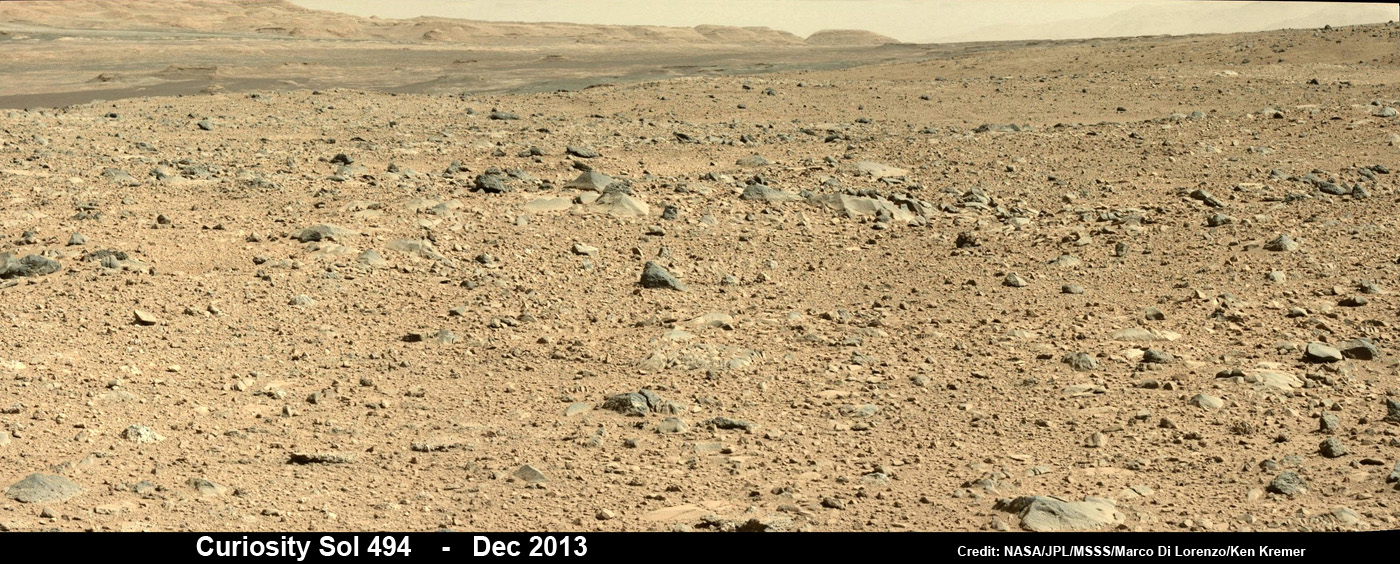
Curiosity Celebrates 500 Sols on Mars on Jan. 1, 2014.  NASA's Curiosity rover snaps fabulous new mosaic spying towering Mount Sharp destination looming dead ahead with her high resolution color cameras, in this cropped view. See full mosaic below. Imagery assembled from Mastcam raw images taken on Dec. 26, 2013 (Sol 494).   Credit: NASA/JPL/MSSS/Marco Di Lorenzo/Ken Kremer- kenkremer.com

Curiosity Celebrates 500 Sols on Mars on Jan. 1, 2014
NASA's Curiosity rover snaps fabulous new mosaic spying towering Mount Sharp destination looming dead ahead with her high resolution color cameras, in this cropped view. See full mosaic below. Imagery assembled from Mastcam raw images taken on Dec. 26, 2013 (Sol 494).
Credit: NASA/JPL/MSSS/Marco Di Lorenzo/Ken Kremer- kenkremer.com


Today, New Year's Day 2014, NASA's Curiosity mega rover celebrates a huge mission milestone – her 500th Martian Day on the Red Planet since the death defying touchdown of August 2012.

"500 Sols of Mars: While Earth celebrates #NewYear2014, midnight on Mars mark my 500th day of operations," she tweeted today.

And Curiosity marked the grand occasion by snapping a fabulous new panorama spying towering Mount Sharp – looming dead ahead in her high resolution color cameras.

You can take in the magnificent Martian view Curiosity sees today – via our newly assembled mosaic of humongous Mount Sharp rising 5.5 kilometers (3.4 mi) into the Red Planets sky; see above and below.

Ascending mysterious Mount Sharp – which dominates the Gale Crater landing site – is the ultimate reason for Curiosity's being.

Curiosity marks 500 Sols on Mars on New Year's Day Jan. 1, 2014. Credit: NASA/JPL

Curiosity marks 500 Sols on Mars on New Year's Day Jan. 1, 2014. Credit: NASA/JPL

NASA's science and engineering teams dispatched the state-of-the-art robot there because they believe the lower sedimentary layers hold the clues to the time period when Mars was habitable eons ago and they possess the required chemical ingredients necessary to sustain microbial life.

But first she needs to reach the mountains foothills.

So, just like some Earthlings, Curiosity also set a New Year's resolution she'd like to share with you all – just tweeted all the way from the Red Planet.

"Goals for 2014: Finish driving to Mars' Mount Sharp & do all the science I can."

Curiosity Celebrates 500 Sols on Mars on Jan. 1, 2014.  NASA's Curiosity rover snaps fabulous new mosaic spying towering Mount Sharp destination looming dead ahead with her high resolution color cameras. Imagery assembled from Mastcam raw images taken on Dec. 26, 2013 (Sol 494).   Credit: NASA/JPL/MSSS/Marco Di Lorenzo/Ken Kremer- kenkremer.com

Curiosity Celebrates 500 Sols on Mars on Jan. 1, 2014. NASA's Curiosity rover snaps fabulous new mosaic spying towering Mount Sharp destination looming dead ahead with her high resolution color cameras. Imagery assembled from Mastcam raw images taken on Dec. 26, 2013 (Sol 494). Credit: NASA/JPL/MSSS/Marco Di Lorenzo/Ken Kremer- kenkremer.com

Part of those goals involve shifting the missions focus to include the search for organic molecules – the building blocks of life as we know it – which may be preserved in the sedimentary rock layers.

"Really what we're doing is turning the corner from a mission that is dedicated to the search for habitable environments to a mission that is now dedicated to the search for that subset of habitable environments which also preserves organic carbon," Curiosity Principal Investigator John Grotzinger, of the California Institute of Technology in Pasadena, said recently at the Dec. 2013 annual meeting of the American Geophysical Union (AGU).

The 1 ton behemoth is in the midst of an epic trek to destination Mount Sharp, roving across 10 kilometers (6 mi.) of the rather rocky crater floor of her landing site inside Gale Crater.

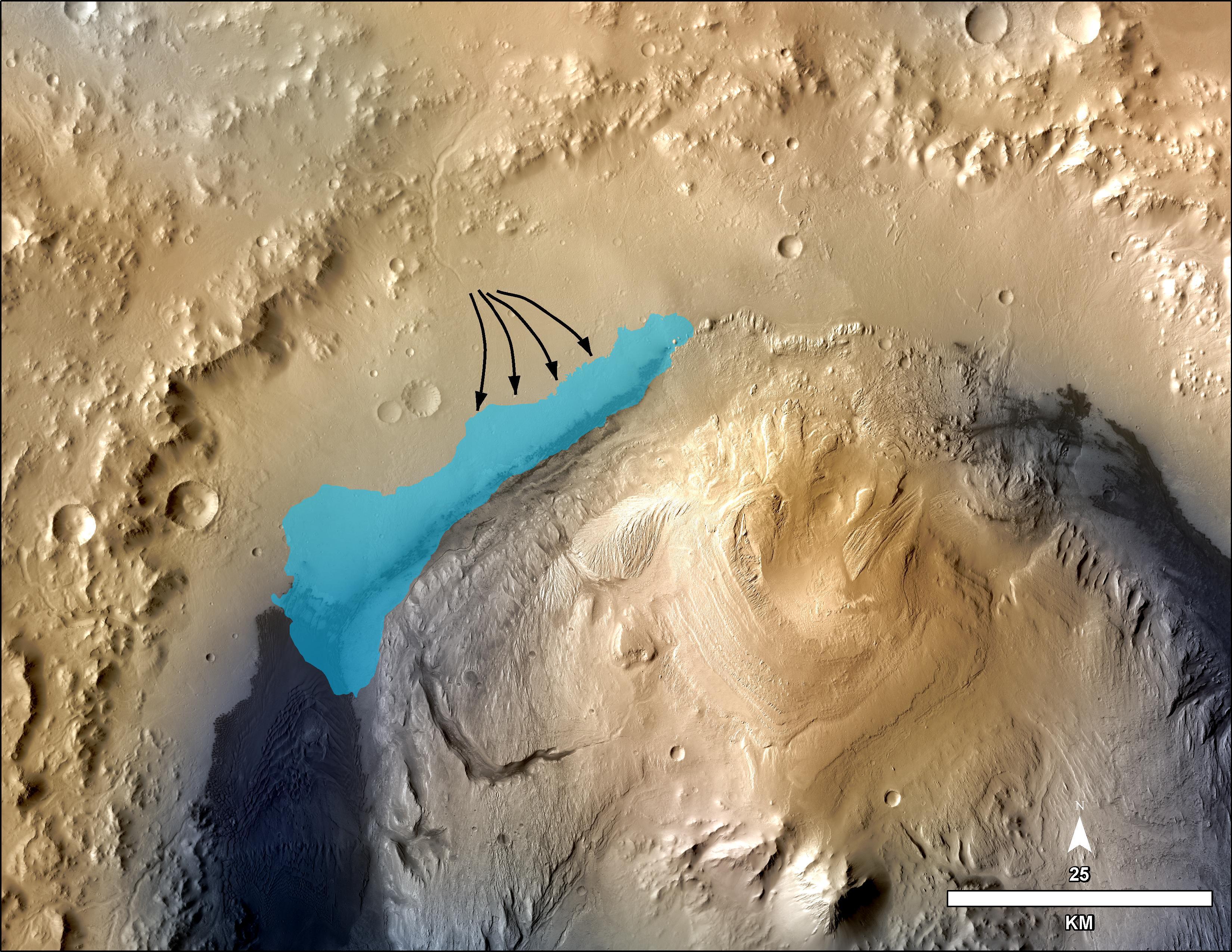
This illustration depicts a concept for the possible extent of an ancient lake inside Gale Crater. The existence of a lake there billions of years ago was confirmed by Curiosity from examination of mudstone in the crater's Yellowknife Bay area.  Credit: NASA/JPL-Caltech/MSSS

This illustration depicts a concept for the possible extent of an ancient lake inside Gale Crater. The existence of a lake there billions of years ago was confirmed by Curiosity from examination of mudstone in the crater's Yellowknife Bay area. Credit: NASA/JPL-Caltech/MSSS

But the alien crater floor strewn with a plethora of sharp edged rocks is ripping significant sized holes and causing numerous dents in several of the rovers six big aluminum wheels – as outlined in my prior report; here.

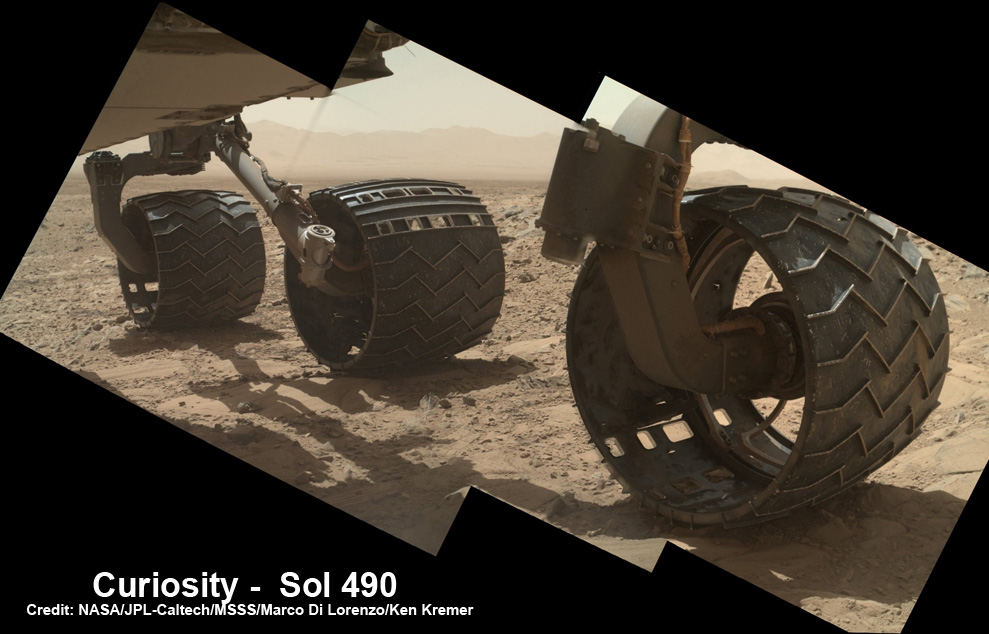
Photomosaic shows new holes and tears in several of rover Curiosity's six wheels caused by recent driving over sharp edged Martian rocks on the months long trek to Mount Sharp. Raw images taken by the MAHLI camera on Curiosity's arm on Dec. 22, 2013 (Sol 490) were assembled to show some recent damage to several of its six wheels – most noticeably the two here in middle and front. Credit: NASA / JPL / MSSS / Marco Di Lorenzo / Ken Kremer- kenkremer.com See below complete 6 wheel mosaic and further wheel mosaics for comparison

Photomosaic shows new holes and tears in several of rover Curiosity's six wheels caused by recent driving over sharp edged Martian rocks on the months long trek to Mount Sharp. Raw images taken by the MAHLI camera on Curiosity's arm on Dec. 22, 2013 (Sol 490) were assembled to show some recent damage to several of its six wheels – most noticeably the two here in middle and front. Credit: NASA / JPL / MSSS / Marco Di Lorenzo / Ken Kremer- kenkremer.com

"Routes to future destinations for the mission may be charted to lessen the amount of travel over such rough terrain, compared to smoother ground nearby," says NASA.

So far Curiosity's odometer stands at 4.6 kilometers, following a post Christmas drive on Dec. 26, 2013 (Sol 494) after 16 months roving the Red Planet.

Curiosity's handlers will be diligently watching the wear and tear on the 20 inch diameter wheels. She needs to rove along a smoother path forward to minimize wheel damage by sharp rocks.

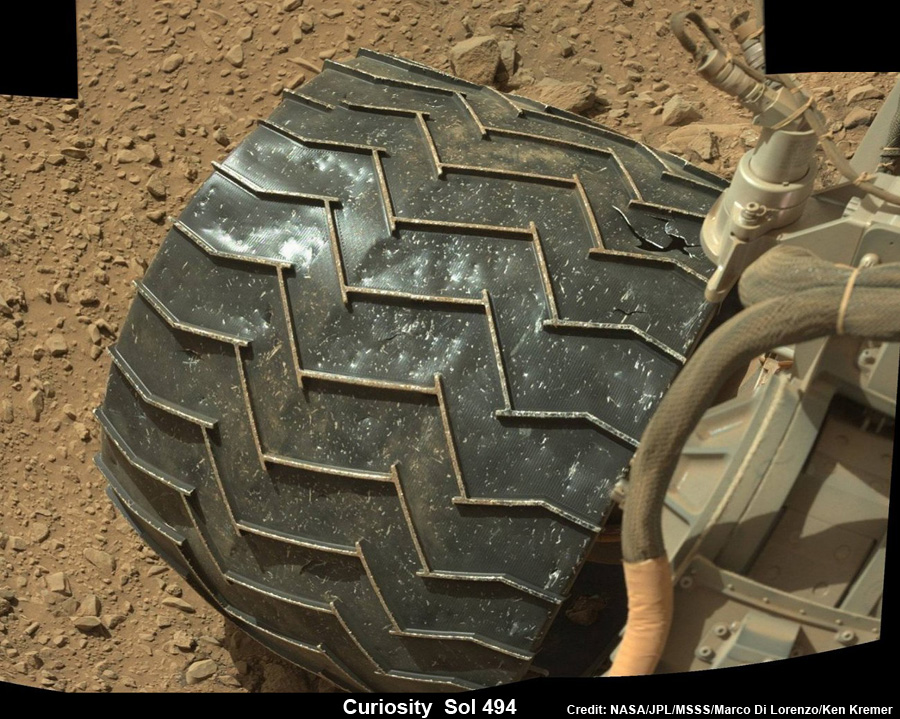
Here's our latest wheel mosaic from Dec. 26, 2013 (Sol 494) showing a several centimeter wide puncture in the left front wheel, which seems to have suffered the most damage.

The Mount Sharp and wheel mosaics were assembled by the imaging team of Marco Di Lorenzo and Ken Kremer.

Up close view of puncture in one of rover Curiosity's six wheels caused by recent driving over rough Martian rocks. Mosaic assembled from Mastcam raw images taken on Dec. 26, 2013 (Sol 494) Credit: NASA/JPL/MSSS/Ken Kremer -kenkremer.com/Marco Di Lorenzo

Up close view of puncture in one of rover Curiosity's six wheels caused by recent driving over rough Martian rocks. Mosaic assembled from Mastcam raw images taken on Dec. 26, 2013 (Sol 494) Credit: NASA/JPL/MSSS/Ken Kremer -kenkremer.com/Marco Di Lorenzo

"Taking stock this holiday season. I'm planning smoother paths for the new year," Curiosity tweeted.

The team hopes the intrepid robot arrives at the base of Mount Sharp around the middle of this new year 2014, if all goes well.

Shortly thereafter the robot begins a new phase with the dramatic ascent up the chosen entryway which the team dubs the 'Murray Buttes' – fittingly named in honor of Bruce Murray, a Caltech planetary geologist, who worked on science teams of NASA's earliest missions to Mars in the 1960s and '70s.

The rocky road ahead towards the base of Mount Sharp and the Murray Buttes entry point is shown in this mosaic from Dec. 26, 2013 (Sol 494).  Curiosity needs to rove along a smoother path forward to minimize wheel damage by sharp rocks.  Credit: NASA/JPL/MSSS/Marco Di Lorenzo/Ken Kremer

The rocky road ahead towards the base of Mount Sharp and the Murray Buttes entry point is shown in this mosaic from Dec. 26, 2013 (Sol 494). Curiosity needs to rove along a smoother path forward to minimize wheel damage by sharp rocks. Credit: NASA/JPL/MSSS/Marco Di Lorenzo/Ken Kremer

Murray also was the director of NASA's Jet Propulsion Laboratory from 1976 to 1982 and co-founded the Planetary Society in 1980. He passed away on Aug. 29, 2013.

"Bruce Murray contributed both scientific insight and leadership that laid the groundwork for interplanetary missions such as robotic missions to Mars, including the Mars rovers, part of America's inspirational accomplishments. It is fitting that the rover teams have chosen his name for significant landmarks on their expeditions," said NASA Mars Exploration Program Manager Fuk Li, of NASA's Jet Propulsion Laboratory (JPL) , Pasadena, Calif.

Curiosity has already accomplished her primary goal of discovering a habitable zone on Mars that could support Martian microbes if they ever existed.

NASA's rover Curiosity uncovered evidence that an ancient Martian lake had the right chemical ingredients, including clay minerals that could have sustained microbial life forms for long periods of time – and that these habitable conditions persisted on the Red Planet until a more recent epoch than previously thought.

Meanwhile, NASA's Opportunity rover is ascending Solander Point on the opposite side of Mars.

And a pair of newly launched orbiters are streaking to the Red Planet; NASA's MAVEN and India's MOM.

And China's new Yutu lunar rover and Chang'e-3 lander are napping through the lunar night.

For a great compilation of the top space events in 2013- read this article.

Stay tuned here for Ken's continuing Curiosity, Chang'e-3, SpaceX, Orbital Sciences, LADEE, MAVEN, Mars rover and MOM news.

Ken Kremer

…………….

Learn more about Curiosity, MAVEN, MOM, Mars rovers, SpaceX, Orbital Sciences Antares Jan. 7 launch, and more at Ken's upcoming presentations

Jan 6-8: "Antares/Cygnus ISS Rocket Launch from Virginia on Jan. 7" & "Space mission updates"; Rodeway Inn, Chincoteague, VA, evening

===============================================================


Fwd: Hot-Fire Test Clears SpaceX for 3 January Launch


Sent from my iPad

Begin forwarded message:

From: "Gary Johnson" <gjohnson144@comcast.net>
Date: January 2, 2014 2:07:20 PM CST
To: "Gary Johnson" <gjohnson144@comcast.net>
Subject: FW: Hot-Fire Test Clears SpaceX for 3 January Launch

AmericaSpace

AmericaSpace

For a nation that explores
January 1st, 2014

All Systems GO For SpaceX To Conduct First U.S. Space Launch Of 2014 On Jan. 3

By Mike Killian


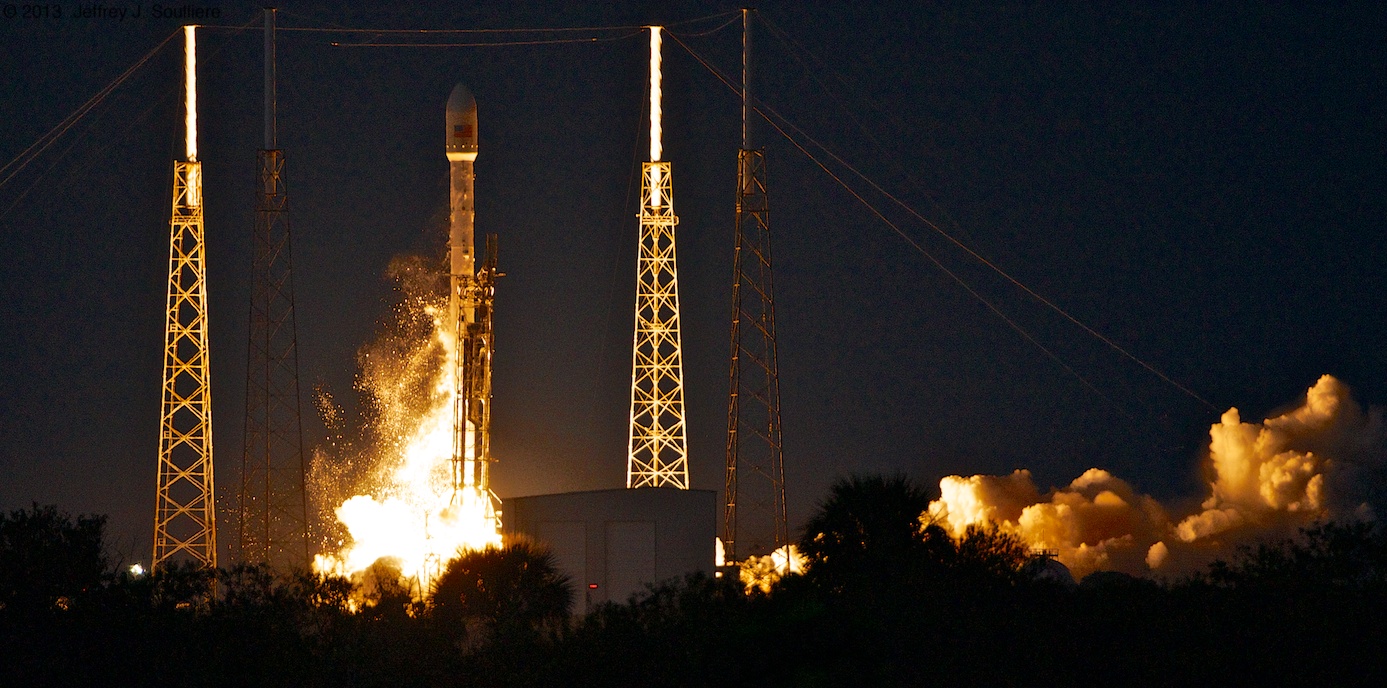
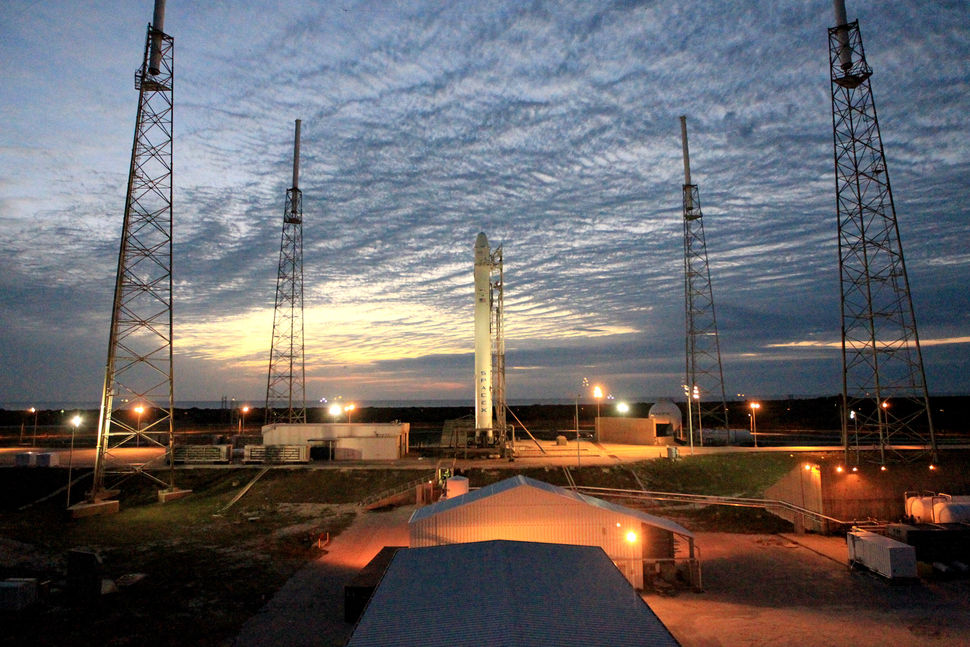
SpaceX will kick off 2013 with their Falcon-9 v1.1 rocket on its third flight this Friday, Jan. 3, to deliver the Thaicom-6 satellite into orbit for Thaicom PLC.  Photo Credit: AmericaSpace /  Jeffrey J. Soulliere

SpaceX will kick off 2013 with their Falcon-9 v1.1 rocket on its third flight this Friday, Jan. 3, to deliver the Thaicom-6 satellite into orbit for Thaicom PLC. Photo Credit: AmericaSpace / Jeffrey J. Soulliere

With 2013 now but a memory America's space program is wasting no time kicking off the new year, with the first U.S. space launch scheduled to blast out of Florida's Cape Canaveral Air Force Station on Friday, Jan. 3, courtesy of Space Exploration Technologies (SpaceX).  The company is scheduled to launch a commercial telecommunications satellite into a geosynchronous transfer orbit (GTO) for Asian satellite operator Thaicom Public Limited Company (PLC).

The 7,330 pound hybrid C-band and Ku-band satellite, identified as Thaicom-6, will launch from Space Launch Complex-40 (SLC-40) atop SpaceX's new upgraded 224-foot tall Falcon-9 v1.1 rocket.  The mission will be the third launch of the new rocket, and will loft Thaicom-6 skyward no earlier than 5:50 p.m. EST, with the launch window extending until 7:17 p.m. EST.

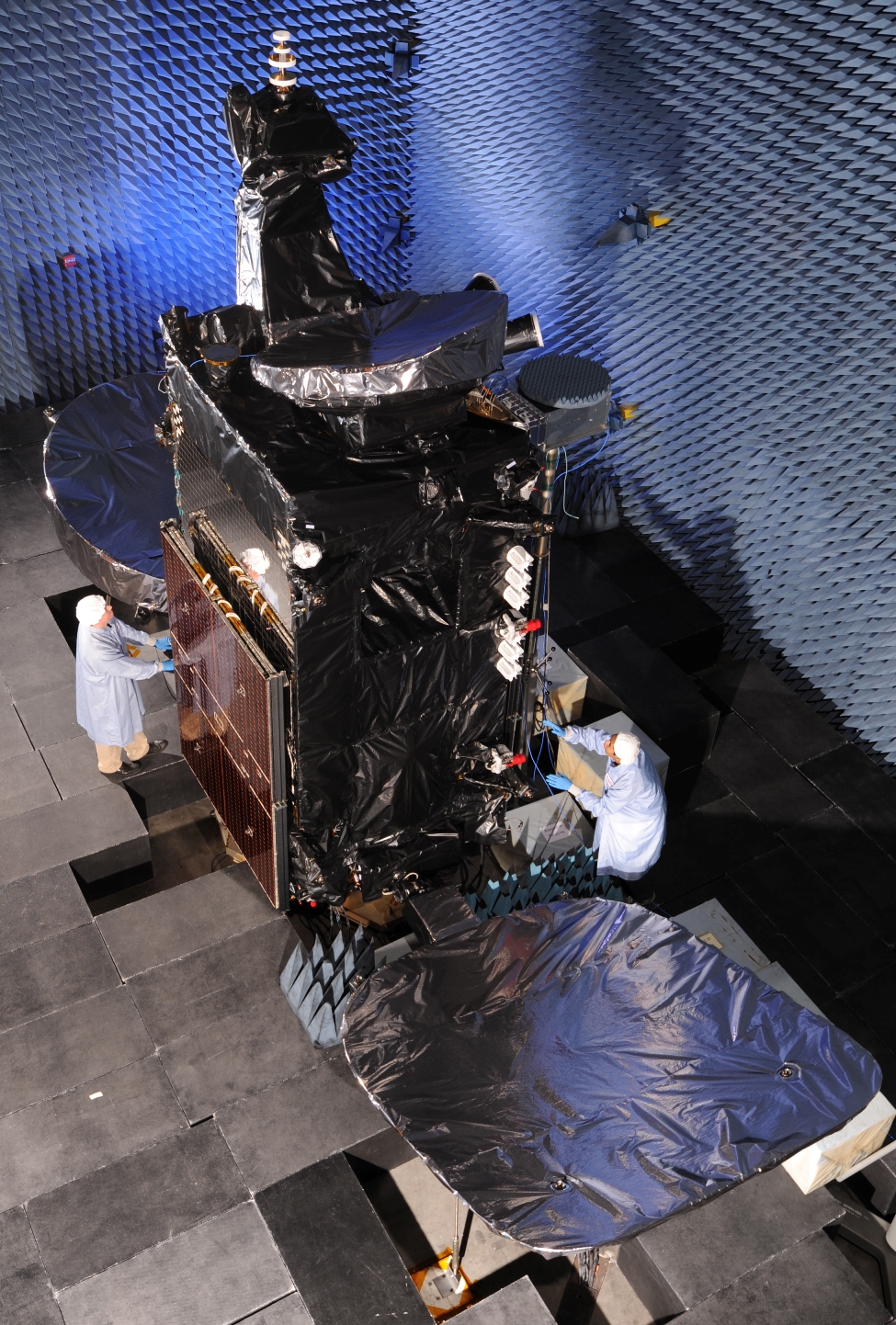
Technicians work on the Thaicom-6 telecommunications satellite at Orbital Science Corporation's Dulles, Virginia facility.  SpaceX is expected to launch the spacecraft atop their new Falcon-9 v1.1 rocket from Florida NET Jan. 3, 2014.  Photo Credit: Orbital Sciences Corporation

Technicians work on the Thaicom-6 telecommunications satellite at Orbital Science Corporation's Dulles, Virginia facility. Photo Credit: Orbital Sciences Corporation

The satellite, which was manufactured and tested by Orbital Sciences Corporation in Dulles, Virginia, was designed based on Orbital's very successful GEOStar-2 satellite platform, which can accommodate all types of commercial communications payloads and is compatible with all major commercial launchers.

Last Saturday SpaceX successfully conducted a Static Fire test on their rocket at Cape Canaveral, hoisting it vertical atop its launch pad and putting the vehicle and launch pad systems through a full countdown scenario which ended with firing of the rocket's nine Merlin 1D engines.  The launch dress rehearsal, according to SpaceX, went as expected, and the team at Cape Canaveral is continuing with work to support a launch attempt in 48 hours.

Once launched the satellite will be placed in a GTO and will be operated at 78.5 degrees East Longitude.  Thaicom-6 is equipped with 18 C-band and 8 Ku-band transponders to provide service coverage to the growing satellite television market in Southeast Asia, South Asia and Southern Africa (including Madagascar).

"This deal highlights the confidence that satellite operators have in SpaceX capabilities, and is the latest example of the effect SpaceX is having on the international commercial launch market," said SpaceX CEO Elon Musk when the deal between SpaceX and Thaicom was announced in 2011.  "Asia is a critical market and SpaceX is honored to support its growing launch needs with a reliable US-based solution."

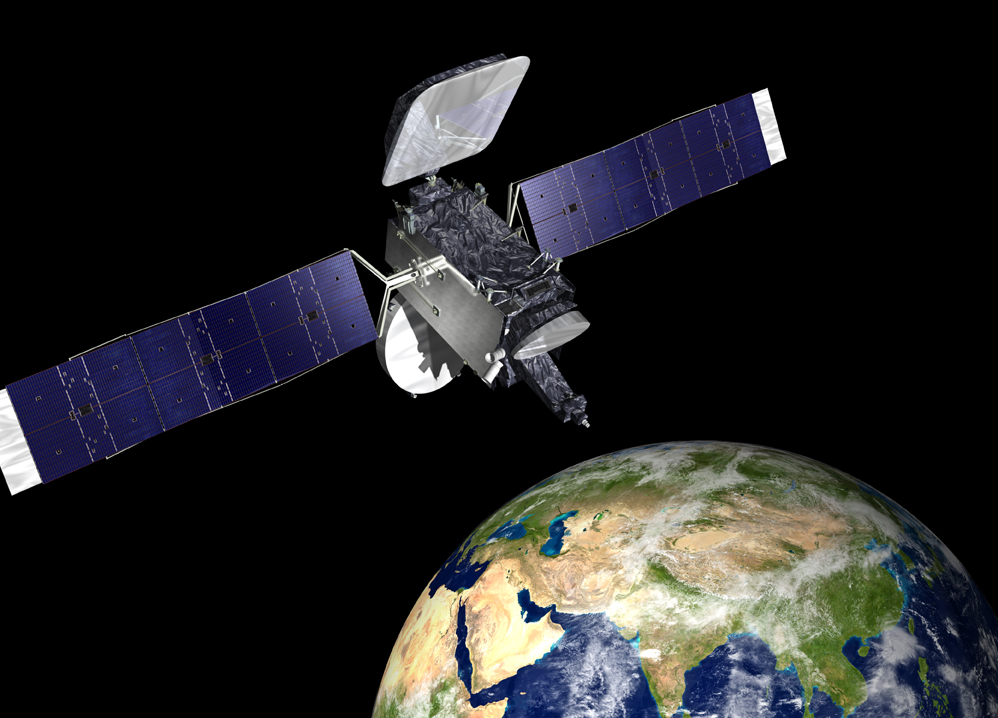
Artist's rendering of Thaicom-6 in orbit.  Image Credit: Orbital Sciences Corporation

Artist's rendering of Thaicom-6 in orbit. Image Credit: Orbital Sciences Corporation

The Kennedy Space Center Visitor Complex is offering launch viewing to the public from the Apollo/Saturn V viewing area, which is roughly 6 miles away from SLC-40 and offers the closest public viewing for this particular launch.  There is an additional charge to be transported to that viewing area, in addition to the regular admission cost to the Visitor Complex.  Off site the alternative free viewing locations would be along the Indian River on HWY-1 in Titusville or along the 528 next to Port Canaveral, although both locations are significantly further than the viewing being offered by the KSC Visitor Complex.

SpaceX launched their first GEO communications satellite, the SES-8 geostationary communications satellite, for SES World Skies into orbit less than a month ago, and in doing so proved they can do more than just deliver to low-Earth orbit.

"The Falcon 9 will serve our unique needs at Thaicom. This dedicated launch vehicle is both cost-effective and best-matched to our requirements," said Arak Chonlatanon, CEO of Thaicom Plc. "We look forward to working closely with the SpaceX team to ensure that the Thaicom 6 satellite will be successfully launched."

Friday's forecast from the 45th Space Wing calls for a 90% chance of favorable conditions expected at T-0, with the only real concern being a chance of strong winds gusting over 30mph, which would violate launch commit criteria.  In the event of a 24-hour scrub the forecast for a Saturday, Jan. 4, launch attempt remains the same.


Copyright © 2014 AmericaSpace - All Rights Reserved


===============================================================


AmericaSpace

AmericaSpace

For a nation that explores
January 2nd, 2014 

Successful Hot-Fire Test Clears SpaceX for 3 January Launch of Thaicom-6

By Ben Evans


Unique trail to the Falcon 9 SES8 Launch Credit: John

The Falcon 9 v1.1 casts an unusual plume trail during its ascent on 3 December to deliver the SES-8 communications satellite into geostationary transfer orbit. Credit: John Studwell

Following a successful static test firing last weekend at Cape Canaveral Air Force Station's Space Launch Complex (SLC)-40, SpaceX stands ready for its second commercial mission to geostationary transfer orbit. Liftoff of the Thaicom 6 communications satellite, aboard the third uprated Falcon 9 v1.1 rocket, is officially targeted to occur within an 87-minute "window," which opens at 5:50 p.m. EST Friday, 3 January. When operational in a 22,240-mile (35,780-km) orbit, Thaicom 6 will provide communications services across Asia, Europe, Australia, and Africa, in addition to offering direct-to-home television coverage to Thailand, Laos, Cambodia, and Myanmar.

Friday's launch attempt will be the first by any nation in 2014 and comes hard on the heels of the standard static test on Saturday, 28 December. According to NASASpaceflight.com, the test put the Falcon 9 v1.1 and SpaceX's launch team through their countdown protocols and culminated in a short firing of the nine Merlin-1D engines on the rocket's first stage. Early indications from SpaceX are that the test ran as expected, clearing the way for this week's Launch Readiness Review, ahead of liftoff.

Built by Orbital Sciences Corp. at its Dulles, Va., manufacturing facility, the 7,330-pound (3,325-kg) Thaicom 6 satellite carries a hybrid C-band and Ku-band communications payload, with 18 C-band and eight Ku-band transponders. Operated by the Thaicom Public Company Limited, headquartered in Bangkok, it will be positioned in geostationary orbit at 78.5 degrees East, co-located with the 2006-launched Thaicom 5. When fully operational, it is expected that Thaicom 6 will remain active for about 15 years.

Technicians work on the Thaicom-6 telecommunications satellite at Orbital Science Corporation's Dulles, Virginia facility.  SpaceX is expected to launch the spacecraft atop their new Falcon-9 v1.1 rocket from Florida NET Jan. 3, 2014.  Photo Credit: Orbital Sciences Corporation

Technicians work on the Thaicom-6 telecommunications satellite at Orbital Science Corporation's Dulles, Va., facility. SpaceX is expected to launch the spacecraft atop their new Falcon-9 v1.1 rocket from Florida NET Jan. 3, 2014. Photo Credit: Orbital Sciences Corporation

"The Thaicom 6 satellite design is based on Orbital's highly successful, flight-proven GEOStar-2 satellite platform," noted Orbital Sciences. "The company's GEOStar product line includes the GEOStar-2 design, which is optimized for smaller satellite missions that can support up to 5.0 kilowatts of payload power." Thaicom 6′s gallium arsenide solar arrays will produce up to 3.7 kW of electrical power for the three-axis-stabilized satellite, with maneuvering capability for station-keeping provided by hydrazine thrusters. Last week, Thaicom Public Company Limited—the Bangkok-headquartered subsidiary of Shin Corporation and principal operator of the new satellite—announced that it had acquired a 66-percent booking on Thaicom 6′s capacity. It was also noted that the satellite would provide "higher quality of the digital TV and more high-definition channels."

Originally targeted for launch on 20 December, the final preparations for the Thaicom 6 launch were pushed to the right as a result of the delayed SES-8 mission, which suffered two scrubbed attempts in late November. This will be the third launch of the uprated Falcon 9 v1.1 rocket, which first flew last September, carrying Canada's CASSIOPE scientitic payload into low-Earth orbit. This success was followed by SpaceX's first mission to geostationary transfer orbit on 3 December, which delivered the SES-8 communications satellite. The new booster is powered by nine Merlin-1D engines on its first stage and a single Merlin-1D Vacuum engine on its second stage.

Tracking an early evening liftoff Friday, SpaceX will poll all stations for their "Go-No Go" status at T-13 minutes, after which the Terminal Count will commence at T-10 minutes. The Falcon 9′s flight control system will be enabled and the nine Merlin-1D engines on the first stage will begin a "chill-down" protocol as part of pre-launch conditioning. Autosequence Start will occur at T-6 minutes, with the rocket's propellant tanks verified to be at their proper flight pressures, and SLC-40′s "strongback" will be completed retracted by T-4 minutes. The Flight Termination System (FTS)—tasked with destroying the Falcon in the event of a major accident during ascent—will be placed onto internal power and armed, and by T-2 minutes and 15 seconds the first stage will reach flight pressure.

At T-1 minute, the flight computer will assume primary control of the vehicle, with the second-stage tanks pressing to flight pressures. SLC-40′s "Niagara" deluge system will begin to flood the pad surface with 30,000 gallons (113,500 liters) of water per minute to suppress acoustic waves radiating from the Merlin-1D exhaust plumes. At T-45 seconds, all tanks will be confirmed at flight pressure. With propellant tanks fully pressurized, at T-3 seconds the nine Merlin-1D engines will roar to life, gradually ramping up to full power and producing a liftoff at 5:50 p.m. EST. The criticality of these final few seconds were highlighted on 28 November—Thanksgiving evening—when the SES-8 countdown was dramatically aborted after engine ignition due to a slower than intended thrust ramp.

SpaceX Falcon 9 rocket CASSIOPE image credit Space Exploration Technologies SpaceX posted on AmericaSpace

The Falcon 9 v1.1 carries great potential, both for ISS support through the Dragon missions and as a commercial launch services provider. Photo Credit: SpaceX

At the instant of liftoff the nine first-stage engines will generate 1.3 million pounds (590,000 kg) of thrust, about 200,000 pounds (90,000 kg) greater than the earlier Falcon 9 v1.0, and will push the vehicle uphill for 180 seconds. Their propulsive yield will gradually rise to 1.5 million pounds (680,000 kg) in the rarefied high atmosphere. "Unlike airplanes, a rocket's thrust actually increases with altitude," noted SpaceX. "Falcon 9 generates 1.3 million pounds of thrust at sea level, but gets up to 1.5 million pounds of thrust in the vacuum of space. The first-stage engines are gradually throttled near the end of first-stage flight to limit launch vehicle acceleration as the rocket's mass decelerates with the burning of fuel."

With around 1,970 seconds of test time and a lengthy qualification program, SpaceX has great confidence in the Merlin-1D. During a full-duration-mission firing in June 2012 in McGregor, Texas, the engine operated at or above the power (147,000 pounds of thrust) and duration (185 seconds) required for a Falcon 9 launch. The Merlin-1D has a vacuum thrust-to-weight ratio in excess of 150:1, making it the most efficient liquid-fueled rocket engine in history. The ignition system for the v1.1′s first stage was tested in April 2013. The stage also includes four extendible landing legs, manufactured from carbon-fiber and aluminum honeycomb, to support a series of tests which SpaceX CEO Elon Musk hopes will lead to vertical-takeoff-vertical-landing (VTVL) capability by the latter half of the present decade.

Immediately after clearing the SLC-40 tower, the Falcon 9 v1.1 will execute a combined pitch, roll, and yaw program maneuver to establish itself onto the proper flight azimuth for the injection of Thaicom 6 into geostationary transfer orbit. Eighty seconds into the ascent, the vehicle will pass Mach 1 and experience a period of maximum aerodynamic stress (known as "Max Q") on its airframe. The Merlin-1Ds will continue to burn hot and hard, finally shutting down at T+2 minutes and 58 seconds, and the first stage will be jettisoned about five seconds later. The turn will then come for two "burns" by the Falcon's restartable second stage, which will ignite for the first time at about T+3 minutes and 10 seconds. Its single Merlin-1D Vacuum engine, with a maximum thrust of 180,000 pounds (81,600 kg), will burn for five minutes to establish the vehicle and Thaicom 6 payload into a "parking" orbit.

A minute into the second-stage flight, the two-piece Payload Fairing (PLF)—a 43-foot-long (13.1-meter) protective cover which encapsulates Thaicom 6—will separate from the vehicle. "Like the inter-stage between the first and second stages," explained AmericaSpace's Launch Tracker in its notes for the inaugural Falcon 9 v1.1 launch on 29 September, "a pneumatic system is used to separate the two halves, rather than the traditional pyrotechnics." Fabricated from carbon-fiber and aluminum-honeycomb, the PLF was extensively tested by SpaceX in April 2013 within the confines of the Reverberant Acoustic Test Facility at NASA's Plum Brook Station in Sandusky, Ohio, part of the Cleveland-based Glenn Research Center.

The first shutdown of the second stage engine will occur at T+8 minutes and 30 seconds, after which the vehicle will coast for 18 minutes, ahead of a second "burn"—lasting about one minute—to carry Thaicom 6 into geostationary transfer orbit. About 35 minutes after launch, the satellite should be released into orbit. Assuming a success on Friday, this launch will kick off an ambitious 2014 manifest for SpaceX, which is presently gearing up to stage at least three Dragon cargo delivery missions to the International Space Station (ISS), with the first targeted for mid-February.


Copyright © 2014 AmericaSpace - All Rights Reserved


===============================================================