Wednesday, October 28, 2015

Fwd: #O2


Sent from my iPad

Begin forwarded message:

From: Kent Castle <kent.d.castle@hotmail.com>
Date: October 28, 2015 at 5:42:52 PM EDT
To: Choban Peter <peter.s.choban@aero.org>, Baird Darren <darren.t.baird@nasa.gov>, Patterson James <w8ljz@aol.com>, Bentz Jerry <bentz@sbcglobal.net>, Astrology Valkyrie <astrogoddess@valkyrieastrology.com>, Madsen Ron <ronstar@pdq.net>, Martin Bobby <bobbygmartin1938@gmail.com>, Leach Larry <ljleach@tds.net>, Bogan Carole <bcbogan@earthlink.net>, Reason Marilou <loganlou55@yahoo.com>
Subject: #O2

Oxygen found on Rosetta's comet: 'Most surprising discovery so far'

Scientists from the Rosetta mission have found oxygen in the atmosphere of comet 67P/Churyumov-Gerasimenko — a discovery that could change our understanding of how the solar system formed. 
The molecular oxygen (O2) was detected by the ROSINA mass spectrometer, one of a suite of instruments aboard the Rosetta spacecraft that has been traveling with the comet since August 2014. 
The revelation came as quite a shock.
Interested in the stories shaping California? Sign up for the free Essential California newsletter >>
"The first time we saw it, we all went a little bit into denial because molecular oxygen was really not expected to be found on a comet," said Kathrin Altwegg of the University of Bern, Switzerland, the project leader for ROSINA, the Rosetta Orbiter Spectrometer for Ion and Neutral Analysis.
"It does not sound that spectacular, but it is actually the most surprising discovery we have made so far on 67P," she said of the comet, which is about to pass the orbit of Mars
Molecular oxygen is common on Earth, but it is rarely seen elsewhere in the universe. In fact, astronomers have detected molecular oxygen outside the solar system only twice, and never on a comet.
Oxygen is highly reactive, meaning it likes to bond to other kinds of atoms. Therefore, it was previously thought that all the oxygen present at the dawn of the solar system would have combined with the abundant hydrogen present at the time to form H20, or water.
Even if some pure oxygen managed to make it out of the primordial cloud of dust and gas from which our solar system emerged, computer models suggest that in the 4.5 billion years since then, the oxygen would have had ample opportunity to be reprocessed, especially in the chaotic early days of the solar system formation. 
"All the models say it shouldn't be there and it shouldn't survive for such a long time," said AndrĂ© Bieler, who studies cometary science at the University of Michigan.
But instead, the ROSINA instrument found that oxygen is the fourth most abundant compound in the gaseous coma of 67P after water, carbon monoxide and carbon dioxide.
"It is not only that we have oxygen, we have a lot of oxygen," Altwegg said. 
To make sure the O2 readings were not caused by an instrumental defect, the team checked oxygen levels at different distances from the comet. The closer to the comet the spacecraft flew, the more oxygen it detected. As it flew farther away, it detected less. 
One way that molecular oxygen can form in space is through a process called radiolysis. This occurs when energetic particles coming off the sun break up the bonds of water ice. Experiments have shown that hydrogen can diffuse out of this process, leaving the oxygen with no other molecules with which to react, Bieler said.
Like all objects in the solar system, comet 67P has been hit with this high-energy radiation for billions of years, but it is unlikely that radiolysis can explain all the oxygen in the comet, the researchers said. High-energy particles from the sun would penetrate only a few meters into the comet's surface. Yet each time the comet flies around the sun, it sheds between one and 10 meters from its circumference.
In a Nature paper describing the discovery, the researchers note that the ratio of water to oxygen in the comet's atmosphere remained the same over the many months that ROSINA was collecting measurements. This suggests that the oxygen is present throughout the body of the comet and not just at its surface, Bieler said. 
And if that's the case, the next logical conclusion is that molecular oxygen was present at the time the comet formed.
This leads to two puzzles for computer modelers to tackle. The first question: What conditions were necessary for molecular oxygen to get trapped in the icy crystals of a comet like 67P? The second: How did that oxygen remain in its pure state for so long?
"This work tells us that the building process of our solar system had to be very gentle for those ice grains to never have really been heated up or reprocessed," Bieler said.
"The cometary community has always said that comets are some of the least-processed bodies in the solar system," he said. "Now we have evidence that at least a significant part of this comet survived the whole formation of our solar system."
That makes it a very pristine object indeed. 
Science rules! Follow me @DeborahNetburn and "like" Los Angeles Times Science & Health on Facebook.
ALSO:
NASA's Cassini spacecraft to dive deep through icy moon's geysers
Rosetta studies reveal a complex cometary world hurtling toward the sun 

Expedition 45 Commander Scott Kelly tries on his spacesuit inside the U.S. Quest airlock of the International Space Station. Kelly and Flight Engineer Kjell Lindgren will venture outside the station for a pair of spacewalks, the first of their careers, on Wednesday, Oct. 28 and Friday, Nov. 6.

Sunday, October 25, 2015

People, You should be MAD AS HELL---- write your reps/ senators REGAIN Shuttle like Capabilities

Look at the waste in all parts of the gov, & the absolutely dumb statements of the liberals. Hell, they aren't even supporting the inferior cots approach. Meanwhile we pay Russia!

Write your reps/senators everyday!
We don't have to put up with this. Start blogging & get your friends to do likewise!

Sent from my iPad

Fwd: 30 Years Since Challenger's Last Successful Mission


Sent from my iPad

Begin forwarded message:

From: "Gary Johnson" <gjohnson144@comcast.net>
Date: October 25, 2015 at 7:56:23 PM CDT
To: "Gary Johnson" <gjohnson144@comcast.net>
Subject: FW: 30 Years Since Challenger's Last Successful Mission


AmericaSpace

AmericaSpace

For a nation that explores
October 24th, 2015


'Dallas? You Mean the City?' 30 Years Since Challenger's Last Successful Mission (Part 1)

By Ben Evans


Thirty years ago, next week, shuttle Challenger launched on her final successful mission. Photo Credit: NASA

Thirty years ago, next week, Shuttle Challenger launched on her final successful mission. Photo Credit: NASA

It is a dismaying fact of history that the name "Challenger"—when spoken in relation to the second spaceworthy vehicle of NASA's shuttle fleet—is so often associated only with the dreadful catastrophe which snuffed out seven lives on the cold morning of 28 January 1986. However, Challenger had flown nine successful missions before tragic 51L, during which she delivered several major satellite payloads into orbit, transported 46 individual astronauts beyond Earth's "sensible" atmosphere, supported six EVAs, and might have gone on to deliver the shuttle's first planetary-bound emissary toward Jupiter. Thirty years ago, in October 1985, Challenger embarked on what would turn out to be her last fully successful mission—a mission which would stand until the end of the shuttle era as the only human spaceflight to both launch and land with as many as eight crew members.

Sadly, only four of those crew members are still with us, following the tragic death of German Payload Specialist Reinhard Furrer in an aircraft accident in September 1995 and last year's trio of untimely passings of Dutch Payload Specialist Wubbo Ockels in May, Commander Hank Hartsfield in July, and Pilot Steve Nagel in August. The others—Mission Specialists Bonnie Dunbar, Jim Buchli, and Guy Bluford and German Payload Specialist Ernst Messerschmid—are therefore the only surviving members of the largest crew ever to launch from Earth into space, aboard a single vehicle. Their flight, Mission 61A, carrying the Spacelab D-1 (for "Deutschland") facility, had been principally financed by then-West Germany, although the European Space Agency (ESA) had contributed a 40-percent share, in return for having one of "its" astronauts aboard Challenger as a unique third Payload Specialist. It was the only occasion in the 30-year shuttle program that as many as three Payload Specialists flew aboard the same mission, although plans existed in the pre-Challenger era for a similar number of non-career astronauts to fly aboard the Sunlab-1 mission in mid-1987.

As with the later flight of STS-73, described in last weekend's AmericaSpace history articles, Spacelab D-1 was intended as an around-the-clock operation, with the entire crew divided into two shifts—the "Red Team" and the "Blue Team"—to run a wide range of scientific and technical experiments throughout the mission. The Red Team was led by Buchli, who oversaw Challenger's flight deck during his 12 hours on-shift, whilst Bluford and Messerschmid focused on the research inside the pressurized Spacelab module. Meanwhile, the Blue Team was led by Nagel, with Dunbar and Furrer working on the science. Meanwhile, Hartsfield and Ockels maintained flexible timelines, anchoring their schedules across both shifts, but usually in line with the Blue Team.
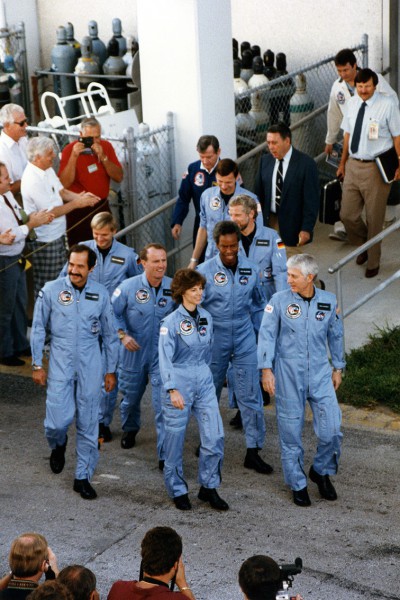
Led by white-haired Commander Hank Hartsfield, the crew of Mission 61A departs the Operations & Checkout (O&C) Building on 30 October 1985, bound for Pad 39A and their ship, Challenger. Photo Credit: NASA, via Joachim Becker/SpaceFacts.de

Led by white-haired Commander Hank Hartsfield, the crew of Mission 61A departs the Operations & Checkout (O&C) Building on 30 October 1985, bound for Pad 39A and their ship, Challenger. Photo Credit: NASA, via Joachim Becker/SpaceFacts.de

Due to the 24-hour activities, the respective halves of the 61A were required to "sleep-shift" in the days preceding their launch on 30 October 1985. "Jim, Ernst and I had to do a circadian rhythm shift," remembered Bluford in his NASA oral history, "so, for us, the launch was coming near the end of our work day. While in quarantine, one team was up, while the other was in bed. A new lighting system had been installed in the crew quarters to facilitate the shift in circadian rhythm. Once we got on-orbit, the Blue Team activated Spacelab, while the Red Team went to bed. We had four soundproof bunks to sleep in, while the Blue Team was at work. The two-shift operations worked very well on-orbit, with both teams up at the same time during breakfast and dinner, when we transferred Spacelab operations. The simultaneous transfer of responsibility—both on-orbit, as well as on the ground—went smoothly, as we exchanged information and updated our Flight Data Files. Each of the crew shared a sleep bunk with a member from the opposite team."

With a 54.1-percent financial stake in Spacelab, it is unsurprising that West Germany had committed itself to at least one "dedicated," national mission of the reusable research facility. Even Mission 61A's launch time of 12:00 noon EDT—"banker's hours," Bonnie Dunbar later joked—had been carefully timed, to allow for maximum television coverage in West Germany. Dunbar, Bluford, and Nagel had been training since February 1984, with NASA having noted at the time that it intended "to have three-member crews share flight deck responsibilities on future Spacelab-type missions." Six months later, in August, the names of Hartsfield and Buchli were attached to Spacelab D-1, which had by then also gained its trio of Payload Specialists. Originally listed as "Mission 51K," it was initially assigned to Atlantis, then Columbia, and eventually Challenger, although unlike many other flights its projected launch date remained fixed in the September-October 1985 timeframe.

In her NASA oral history, Dunbar remembered that her early training brought her face-to-face with some of the same prejudices which she had seen as a young woman, trying to enter an engineering career. Many of the West German medical experiments for the $180 million Spacelab D-1 were not intended to include female blood and there existed concerns that it might ruin their data. She remembered being told, to her face, and wryly wondered if NASA had deliberately assigned her to the mission, in order to offend the Germans. Equally, the Vestibular Sled, which would run along the center aisle of the Spacelab module, did not fit her, and it was eventually George W.S. Abbey, then-head of the Flight Crew Operations Directorate, who came to her aid and insisted that the Germans redesign their equipment to the percentile spread which included Dunbar.

As training progressed, she learned German and developed a good working relationship with her crewmates, including Reinhard Furrer. There was occasional time for banter, too, particularly when Furrer expressed astonishment that Dunbar had never heard of the television show, Dallas. When he first asked her about it, she was convinced he meant the Texan city, but to be fair her engineering career had consumed her and watching television had been the last thing on Dunbar's mind. The crew trained at Porz Wahnheide, south of Cologne, as well as at NASA's Marshall Space Flight Center (MSFC) in Huntsville, Ala., in order to prepare for a total of 76 experiments in life and materials sciences. With names like Werkstofflabor, Prozesskamer, Biowissenschaften, and Biorack, they sounded like fearsome medieval tools of torture, but in fact ran the gamut in studying materials processing, fluid physics, and the behavior of biological organisms in space.

Spacelab D-1's mission designation eventually shifted from "51K" to "61A" and would become the first shuttle flight to be run from outside the United States. Although the Mission Control Center (MCC) in Houston, Texas, retained overall control, the German Space Operations Centre (GSOC) at Oberpfaffenhofen, just outside Munich, managed daily research activities. Over the course of the mission, this worked well, with the exception that Oberpfaffenhofen's limited data-transmission facilities meant that a number of functions had to be overseen by JSC. Moreover, with only one Tracking and Data Relay Satellite (TDRS) operational at the time, Spacelab D-1 would receive minimal communications coverage over about 30 percent of each orbit and it was left to the Intelsat V geostationary satellite to relay data to an Earth station at Raisting in Bavaria and from thence to Oberpfaffenhoften, via microwave link. "Not having a U.S. mission manager made it more complex," Steve Nagel remembered, years later, "but I see [Spacelab D-1 as] an early lead-in to the space station. It was hard for Hank to pull together and complicated when you're dealing overseas. We got along fine with the Germans, but we butted heads about things and the long-distance part made it more complex."
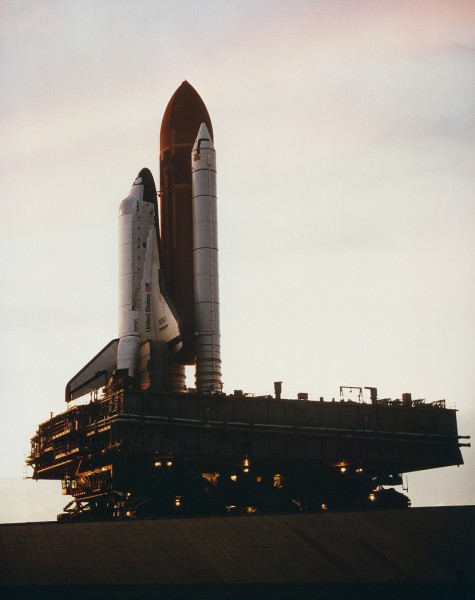
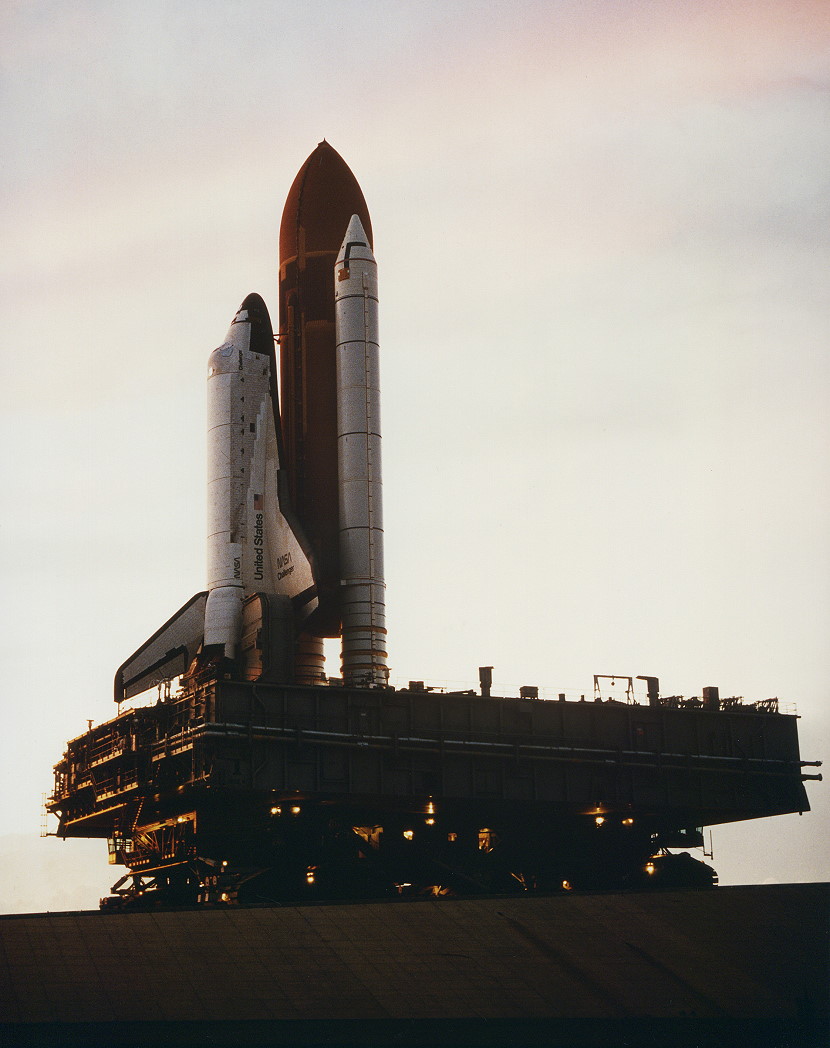
Beautiful view of Challenger, rolling out to Pad 39A for the last time. Her next mission, tragic 51L, would fly from Pad 39B. Photo Credit: NASA, via Joachim Becker/SpaceFacts.de

Beautiful view of Challenger, rolling out to Pad 39A for the last time. Her next mission, tragic 51L, would fly from Pad 39B. Photo Credit: NASA, via Joachim Becker/SpaceFacts.de

Despite the focus of the mission and the common language currency always being English, on a few occasions German was spoken over the space-to-ground communications link, including one opportunity for Messerschmid and Bluford to speak to the head of Bavaria. "The conversation was conducted in German with Ernst doing all the talking," Bluford remembered years later. "Although the mission's dialogue was conducted primarily in English, infrequently, the Payload Specialists would revert to German during on-orbit discussions." Hartsfield remembered that the decision was a controversial one, with the Germans insisting that their language be spoken to controllers at a German site in Bavaria. "I opposed that, for safety reasons," he explained. "We can't have things going on in which my part of the payload crew can't understand what they're getting ready to do. It was clearly up front: the operational language will be English. We finally cut a deal … that in special cases, where there was real urgency, that we could have another language used, but before any action is taken, it has to be translated into English so that the commander or my other shift operator lead and the payload crew can understand it."

For Steve Nagel, Spacelab D-1 offered him the chance to fly a second shuttle mission within just four months in 1985, creating a personal landing-to-launch record which would endure for more than a decade. Originally named as a member of Mission 51A, planned for October 1984, Nagel's first flight was repeatedly postponed and eventually flew as Mission 51G in June 1985. However, his second flight didn't move. He spoke to 51G Commander Dan Brandenstein, who talked to George Abbey and negotiated for Nagel to remain on both missions. "I don't think they'd ever do that today," Nagel reflected, years later, "so I owe Dan for the fact that I was able to hang onto both of those."

As a result, when Challenger rose from Pad 39A at the stroke of midday on 30 October 1985, a mere 128 days separated Nagel's first shuttle landing and his second shuttle launch. This record would not be broken until the summer of 1997, when the entire STS-83 crew flew a shortened mission in April and were rapidly recycled to fly again in July. But Nagel can have had little time to ponder his good fortune, for he also occupied a different role on his second flight, moving from a Mission Specialist to the Pilot's seat. In the seconds after liftoff, as Hartsfield and Nagel monitored their instruments, a 102-degree "Roll Program" maneuver positioned Challenger onto the proper flight azimuth for a 200-mile (320-km) orbit, inclined 57 degrees to the equator.

The next seven days would be the last time that Challenger would ever fly in space.


Copyright © 2015 AmericaSpace - All Rights Reserved


AmericaSpace

AmericaSpace

For a nation that explores
October 25th, 2015

'The Most Beautiful Thing': 30 Years Since Challenger's Last Successful Mission (Part 2)

By Ben Evans


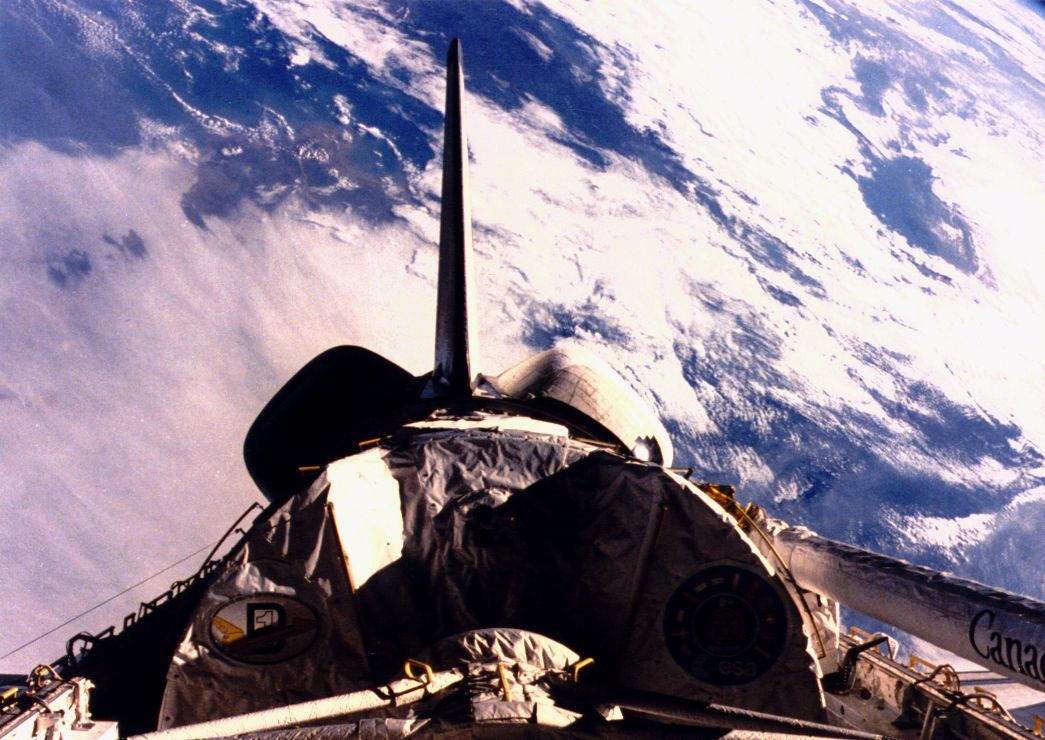
In one of the final views of Challenger in space, the orbiter sails over the cloud-bedecked Earth, with the Spacelab D-1 module clearly visible in her payload bay. Photo Credit: NASA, via Joachim Becker/SpaceFacts.de

In one of the final views of Challenger in space, the orbiter sails over the cloud-bedecked Earth, with the Spacelab D-1 module clearly visible in her payload bay. Photo Credit: NASA, via Joachim Becker/SpaceFacts.de

Thirty years ago, next week, Space Shuttle Challenger flew in space for the final time. Mission 61A—the ninth and last orbital voyage for the second space-rated shuttle—would make history by becoming the first U.S. piloted spaceflight to be controlled from outside the United States. Yet it also has an as-yet-unassailed place in the history books. As outlined in yesterday's AmericaSpace history article, Commander Hank Hartsfield and Pilot Steve Nagel were joined by Mission Specialists Bonnie Dunbar, Jim Buchli, and Guy Bluford, together with Payload Specialists Reinhard Furrer and Ernst Messerschmid of then-West Germany and Wubbo Ockels of Holland, producing the world's first eight-member spacefaring crew. Although STS-71 in mid-1995 would return to Earth with eight crew members, it would launch with seven, and Mission 61A therefore remains unique in the annals of space exploration for having transported the largest-ever number of people to and from orbit aboard the same vehicle.

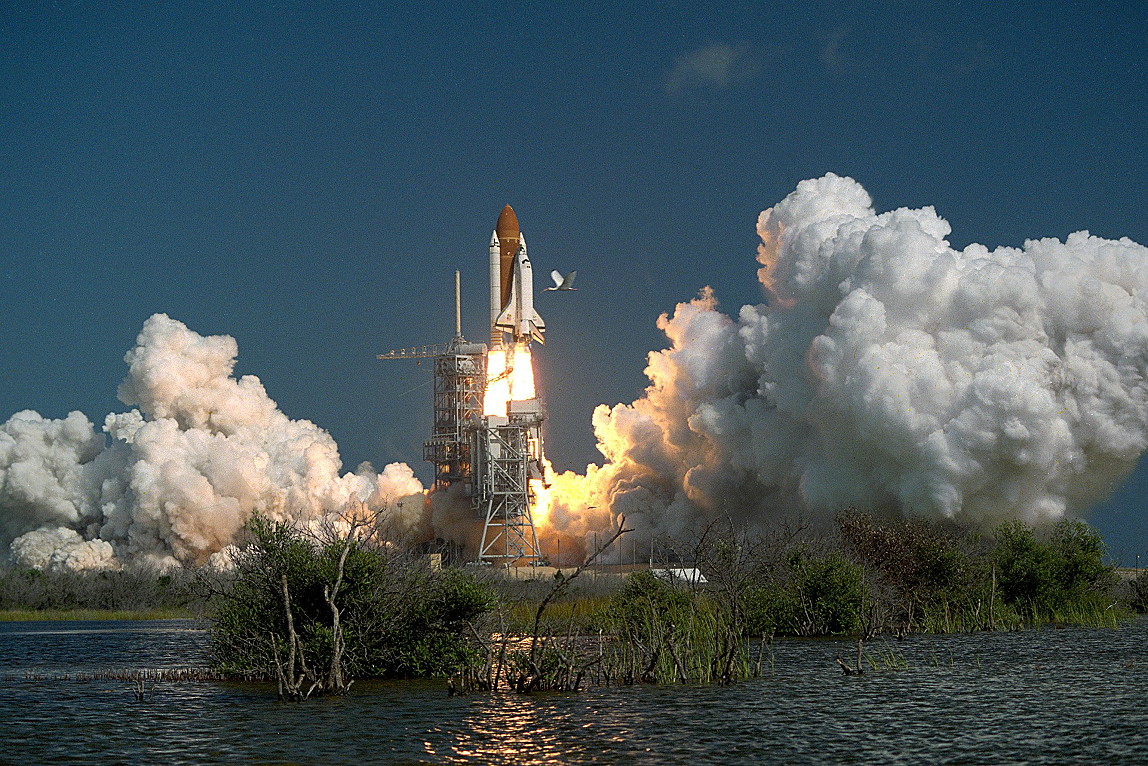
Launched at precisely midday EST on 30 October 1985—and flying for what would turn out to be her final time from Pad 39A—Challenger was inserted into an orbit of 200 miles (320 km), inclined 57 degrees to the equator, after which the "Blue Team," led by Steve Nagel, set to work configuring the vehicle for seven days of operations and activating 76 life and microgravity science experiments in the pressurized Spacelab D-1 (for "Deutschland") facility in the payload bay. In order to handle around-the-clock research, Nagel, Dunbar, and Furrer's shift was balanced by the "Red Team" of Buchli, Bluford, and Messerschmid, although Hartsfield and Ockels tended to align their work schedules with the Blue Shift. "Wubbo decided to freelance," remembered Hartsfield. "He didn't have a fixed shift. His shift would overlap the other two shifts. It was kind of a weird arrangement. He chose to sleep in the airlock. He had a sleeping bag and the only trouble was that people going back and forth would bump him as they went through there." At the post-flight press conference, Hartsfield jokingly referred to Ockels as the "Purple Team."

In honor of the traditions of his Dutch homeland, Ockels took a large bag of gouda cheese as part of his personal allowance. "The coolest part of the vehicle," said Hartsfield, "was the tunnel that went from the middeck to the lab. He taped that bag of gouda up in the tunnel. It was so convenient that anybody that went there—on the way back and forth—reached in. About the second or third day, he was upset because two-thirds of his cheese was gone!"

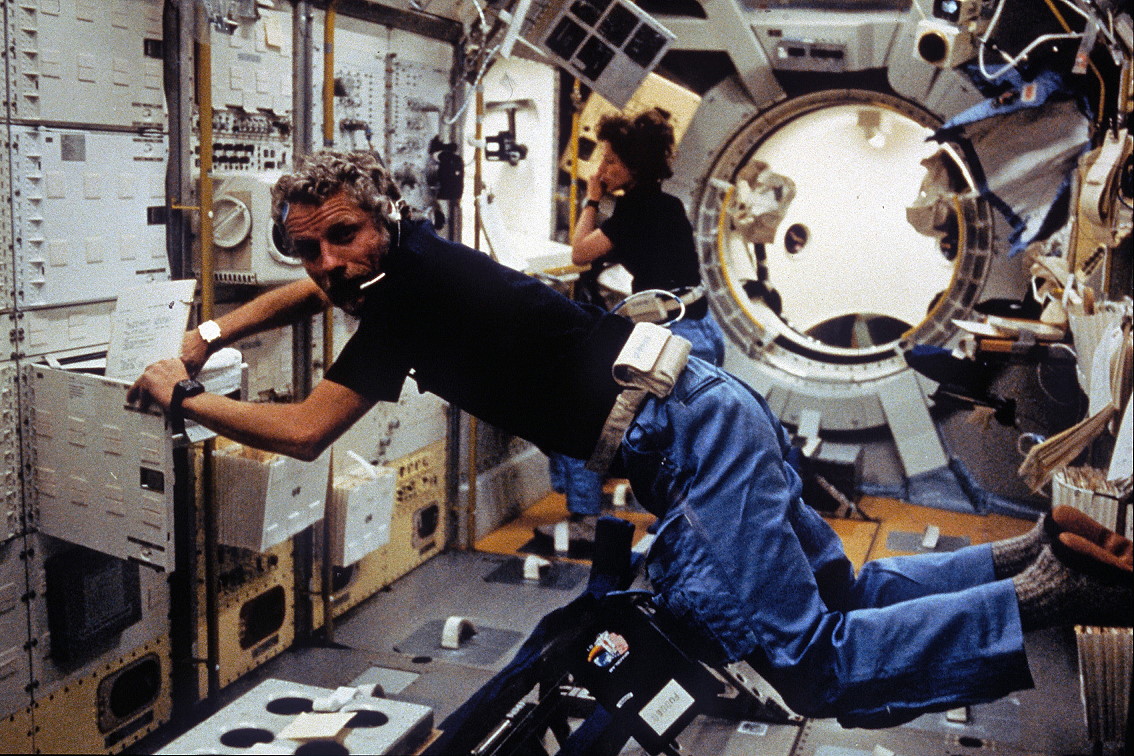
Reinhard Furrer and Bonnie Dunbar at work inside the Spacelab module. Photo Credit: NASA, via Joachim Becker/SpaceFacts.de

Reinhard Furrer and Bonnie Dunbar at work inside the Spacelab module. Photo Credit: NASA, via Joachim Becker/SpaceFacts.de

In a manner not dissimilar to the Spacelab-3 mission, earlier in 1985, Challenger was oriented in a gravity gradient attitude to provide a quiescent microgravity environment for the on-board materials processing and fluid physics investigations. "There's a little bit of atmospheric drag, even at those altitudes, and there's a gravity effect from one end of the shuttle to the other," explained Nagel, "which will cause it to change attitudes, so you get it in a stable attitude before you turn the jets off. This is interesting, because usually you want the long axis pointed at the Earth, either tail to the Earth or nose to the Earth, and the wing oriented in some way that it'll be fairly stable. And we would get it in this attitude, which was nose at the Earth, and the right wing pretty well forward. You 'slide' along like that and get it all stable and turn off the jets, and it would just stay there. It would slowly wander around a little bit and roll over a long period, like half-hour or so, kind of oscillate. It made for very interesting Earth viewing; it's almost like you're suspended in a gondola."

Perhaps demonstrative of the relative monotony of Spacelab flights for pilots, Nagel's job consisted of periodically purging the fuel cells, dumping waste water, taking photographs, and preparing meals for the rest of the crew on his shift. "But the good thing about the mission," he said, "was the high inclination. We flew 57 degrees, which means you cover most of the inhabited part of the world. It was just a bonanza of Earth observations. We shot all of our film." For Hartsfield, the comparatively relaxed pace for the "orbiter crew" allowed him to indulge in some light-hearted banter, particularly as Halloween coincided with Challenger's second day in space. "I took the back off one of the ascent checklists," he said, "drew a face on it, cut out eye holes, got some string and made a mask! I took one of the stowage bags and went trick-or-treating in the lab. They don't do Halloween in Germany, so they didn't know what I was up to! I decided not to pull any tricks on them, but I didn't get much in my bag. One of the guys took a picture of me with that mask on, and somehow it got released back in the U.S. About a month after the flight, I got a letter from a congressman who had a complaint from one of his constituents about her tax money being spent to buy toys for astronauts! I had to explain that nothing was done and it was made in flight from material we didn't need anymore. It was just fun."

The final full flight of Challenger passed remarkably quietly. One of the few problems experienced was a cabin leak, which triggered alarms on several occasions. "We discovered, later on, the leak was due to one of the experiments inadvertently venting into space," said Bluford. "We also had a false fire alarm go off on us during flight." Nonetheless, despite the hectic, around-the-clock pace, some time was granted to each spacefarer simply to gaze down on the Home Planet.

The first spaceflight to launch and land with as many as eight crewmates, Mission 61A retains its unique place in the annals of human space exploration to this day. Photo Credit: NASA, via Joachim Becker/SpaceFacts.de

The first spaceflight to launch and land with as many as eight crewmates, Mission 61A retains its unique place in the annals of human space exploration to this day. Photo Credit: NASA, via Joachim Becker/SpaceFacts.de

"We were flying into darkness, passing over Tasmania," Buchli told a Smithsonian interviewer, years later, "and heading down toward Antarctica. The southern aurora was just unbelievable! It looked like an octopus sitting over the South Pole, with tentacles of light coming out. The orbiter was flying upside down, with the nose pointing toward the pole, and the tentacles shimmered a fluorescent blue-pink. It was like the whole nose was bathed in aurora. Even though we were much higher, you could still see the glow off the front of the nose. I knew what was coming, because I had seen the same geometry when we passed over the pole the day before. I went down to the middeck and literally grabbed Reinhard Furrer, who was on the other shift … and stuffed him up there in the nose of the vehicle. We're lying upside down, with all the switches and circuit breakers next to our chests, and we're peeking out the front windows, straining to look to the side of the orbiter. For probably ten minutes, we watched these shimmering bands coming off the South Pole. Finally, Reinhard said "Jim, that was fantastic! That was the most beautiful thing I've ever seen." Then he went back downstairs to work."

Returning to a landing at Edwards Air Force Base, Calif., on 6 November, the shuttle's descent to the desert runway was picture-perfect. "Challenger, we show you on-glideslope, on-centerline," came the call from the Capcom, seated in the Mission Control Center (MCC) at the Johnson Space Center (JSC) in Houston, Texas. "Surface winds are calm."

"Roger," came the call from Hartsfield.

A few seconds later, Nagel deployed the landing gear and Hartsfield brought his ship to a smooth touchdown on Runway 17 at 9:44 a.m. local time, wrapping up a mission of just a little over seven full days. During rollout, he performed a computerized steering test of Challenger's nose landing gear, ahead of plans to resume shuttle landings at the Kennedy Space Center (KSC) in Florida, following an instance of seized brakes and a burst tire at the end of Mission 51D in April 1985. Although he considered the test a success, Hartsfield felt that attempting KSC landings was somewhat premature. In 49 seconds, and around 9,840 feet (3,000 meters), he brought Challenger to a halt and announced "Wheels Stop."

"Roger, wheels stop, Challenger," came the reply from the Capcom. "Welcome home and congratulations on a beautiful flight. Henry, we're working on your post-landing deltas and we'll get right back to you."

Looking back with the benefit of hindsight, it is difficult not to view Mission 61A as the final swansong of Challenger's career, for less than three months later—on 28 January 1986—and through no fault of her own, she would vanish in a fireball, killing her 10th crew and stalling the entire shuttle program for almost three years. Hindsight bias, of course, allows us to regard Spacelab D-1 as the end of an era, which in a sense it was for Challenger, but on the other hand a bright future might have stretched ahead of her in 1986. As described in a previous AmericaSpace article, the "moderately complex" Mission 51L, with its already-baselined satellite deployment and retrieval activities, would have been followed by Challenger becoming the first shuttle to launch a spacecraft onto an interplanetary trajectory. Later in 1986, she would have retrieved NASA's Long Duration Exposure Facility (LDEF) from orbit and would have staged her first classified Department of Defense mission. All told, 1986 might have seen Challenger fly on as many as four occasions for the first time in her spacefaring career.

Alas, in one of the great tragedies of history, it was not to be. And on the freezing morning of 28 January 1986, Challenger's Golden Age came crashing to a premature end.


Copyright © 2015 AmericaSpace - All Rights Reserved


China looks to deep space missions, including more lunar landings and robot ants | Examiner.com

http://www.examiner.com/article/china-looks-to-deep-space-missions-including-more-lunar-landings-and-robot-ants?cid=db_articles


Sent from my iPad

How Newt Gingrich’s moon base became ‘pretty cool’ | TheHill

http://thehill.com/blogs/congress-blog/technology/257501-how-newt-gingrichs-moon-base-became-pretty-cool?utm_source=Today%27s+Deep+Space+Extra%2C+Thursday%2C+October+22%2C+2015&utm_campaign=dailycsextra&utm_medium=email


Sent from my iPad

Typical media illogic which is destroying this GREAT Country!! Shuttle s/b flying TODAY!

The PBS Columbia Documentary is the most extensive example. In it the shuttles are labeled as "worn out, old technology, too risky, too costly, a mistake and not capable of supporting solar system exploration" none of which is true.The initiative has been very effective and after six years the anti shuttle rhetoric has become a media myth.